


When sourcing whiteboards for education facilities, corporate offices, training rooms and commercial projects, buyers always struggle between Enamel Steel Whiteboard and conventional Lacquered Steel Whiteboard. In fact, neither material is absolutely superior. Both have unique advantages and applicable scenarios. The optimal procurement strategy depends entirely on usage intensity, service cycle and budget planning.
We break down the core differences between Enamel Steel Whiteboard and Lacquered Steel Whiteboard in five key dimensions, with straightforward and objective analysis to support scenario-based procurement decisions.
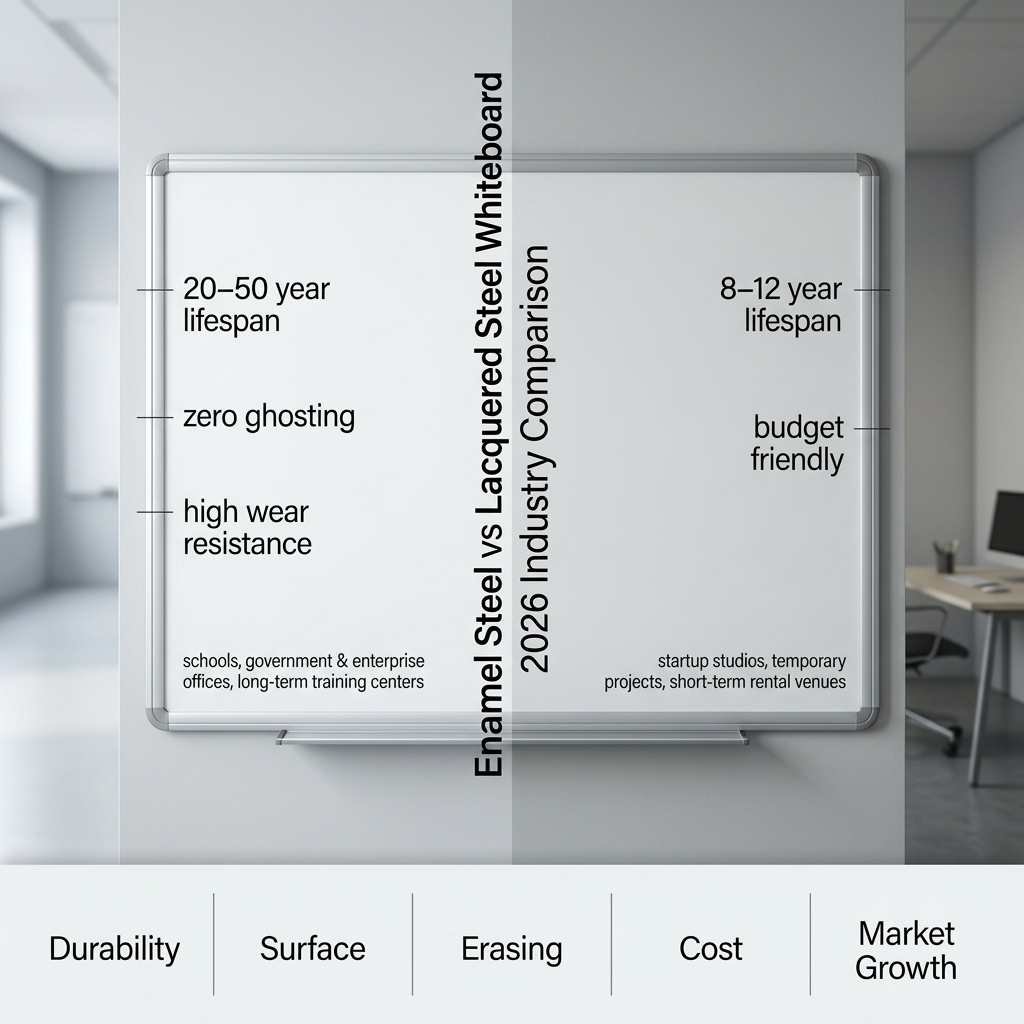
1. Durability & Lifespan
Enamel Steel Whiteboard: Manufactured with high-temperature fused enamel technology, the integrated surface boasts ultra-high hardness, strong scratch resistance and impact resistance. It never peels, bubbles or deforms, with a stable service life of 20–50 years, fully adapting to long-term, high-frequency heavy daily use.
Lacquered Steel Whiteboard: Adopts conventional surface lacquer coating with moderate hardness. It is prone to scratches and coating wear after long-term frequent use. The regular service lifespan is only 8–12 years, requiring regular inspection, maintenance and periodic replacement.
2. Surface Performance
Enamel Steel Whiteboard: Features a dense, non-porous and anti-glare surface with excellent oxidation resistance. It will not yellow, age or absorb ink after years of use, supports high-definition projection display, and maintains stable and lasting magnetic adsorption performance.
Lacquered Steel Whiteboard: The slightly porous lacquered surface is less stable. Long-term use easily causes ink penetration, residual ghost marks, gradual fading and oxidation. Meanwhile, its magnetic effect will weaken continuously as the coating ages.
3. Wiping & Cleaning Ease
Enamel Steel Whiteboard: The smooth and compact surface delivers superior dry-erase performance. Whether it is fresh handwriting or long-residual marker ink, it can be completely wiped clean with a common eraser or wet cloth, leaving no stubborn stains or permanent ghost marks, with almost zero daily maintenance pressure.
Lacquered Steel Whiteboard: It has limited anti-fouling capacity. Timely wiping after use is essential. If ink is left on the surface for a long time, it cannot be thoroughly cleaned, and permanent ghost trails will form, requiring regular manual deep cleaning to keep the surface tidy.
4. Price Gap & Cost Performance
Enamel Steel Whiteboard: It has a higher upfront procurement cost, 2.0–2.8 times that of lacquered steel whiteboards. However, it requires no replacement and little maintenance throughout its service life, resulting in an extremely low long-term comprehensive cost and excellent long-term investment value. Lacquered Steel Whiteboard: It features a low initial price and obvious short-term cost advantages, which is friendly to budget-limited projects. Yet frequent replacement and daily maintenance will generate continuous additional expenses, leading to a higher overall cost in the long run.
5. Customer Procurement Growth Trend (2024–2026)
Enamel Steel Whiteboard: It maintains a robust year-on-year growth of 22.5%, becoming the preferred choice for government education bidding, high-end corporate offices, professional training venues and other long-term fixed standard projects.
Lacquered Steel Whiteboard: The market growth is stable but slow, with an annual increase of only 4.2%. It is mainly applied in startup offices, home studios, short-term rental spaces and various temporary engineering projects.
In short, both enamel steel and lacquered steel whiteboards have irreplaceable practical value, with no absolute distinction between good and bad. Enamel steel excels in long-term stability and low maintenance, while lacquered steel stands out for flexible cost control and basic practicability. The most professional procurement solution is to select the appropriate material based on the customer’s actual usage scenarios, service cycle and budget planning.
Do you agree with this scenario-based selection logic? Welcome to share your project procurement experience below!
Post time: Jun-29-2026