


As digital screens, interactive displays, and online learning tools become increasingly common in classrooms and workplaces, traditional whiteboards continue to play an important role. Their value is not based on technology, but on the natural and effective way they support communication, learning, and human interaction.
More Than a Writing Surface
A traditional whiteboard provides a simple space where ideas can be written, organized, discussed, and developed. Unlike digital screens, it does not require software, charging, network access, or complicated operation. Teachers and students can begin using it immediately, making it a practical and reliable tool for everyday education.
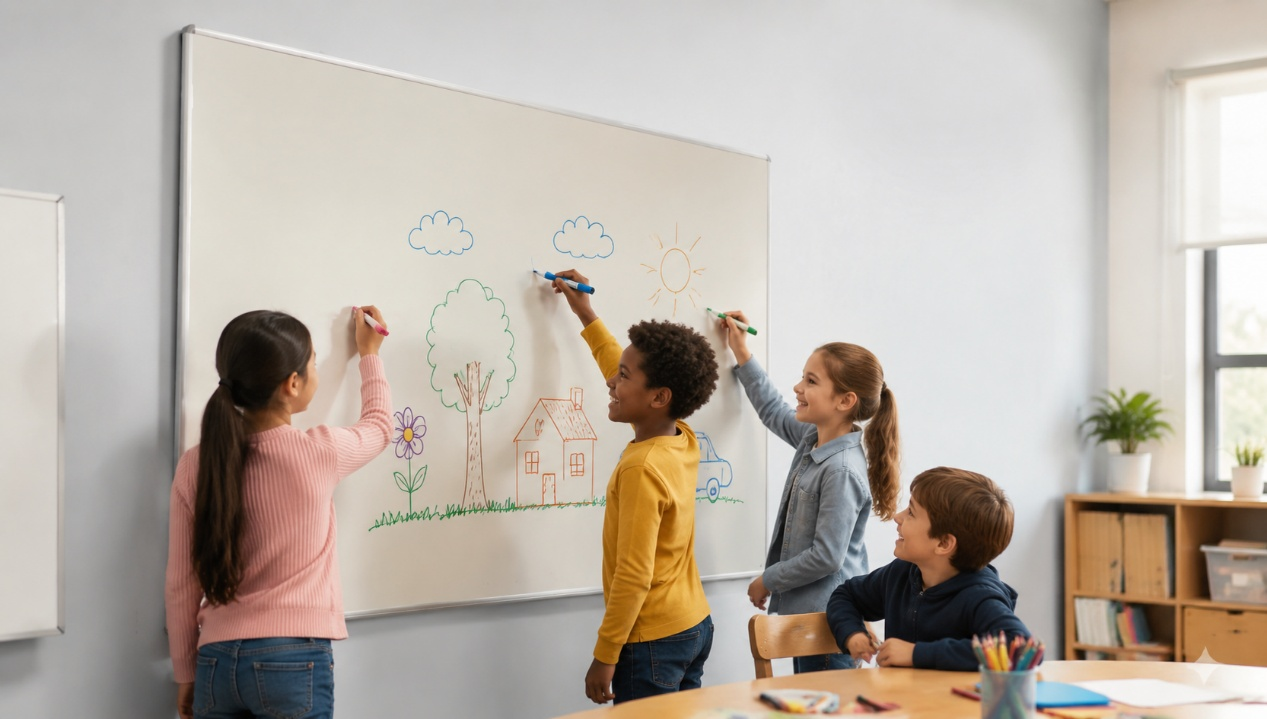
More importantly, writing by hand creates a direct connection between the eyes, hands, brain, and body. When children write, draw, calculate, or arrange information on a whiteboard, they are not only receiving information—they are actively processing and expressing it.
Handwriting Supports Multi-Sensory Learning
For children, handwriting can encourage the coordination of multiple senses and abilities:
●Visual engagement: Children observe letters, numbers, shapes, and visual relationships.
●Hand movement: Writing and drawing help develop hand control and coordination.
●Cognitive processing: Children think about how to organize and express their ideas.
●Language development: Writing by hand can support spelling, vocabulary, and sentence formation.
● Physical participation: Standing up and writing on a board creates a more active learning experience.
● Emotional involvement: Completing a task by hand can give children a stronger sense of participation and achievement.
This combination of visual observation, physical movement, thinking, and expression makes handwriting a valuable part of early learning. It helps turn learning from a passive screen-based activity into a more complete and interactive experience.
Encouraging Independent Thinking and Expression
Digital devices are efficient for presenting information, but traditional whiteboards leave more room for children to explore ideas freely. They can write large or small, draw diagrams, make corrections, and change their ideas as they learn.
In classrooms, a whiteboard also allows teachers to adjust the pace of a lesson according to students’ reactions. Students can participate at the board, solve problems together, and learn from one another. This process helps develop confidence, communication skills, logical thinking, and a positive attitude toward learning.
A Balanced Approach to Modern Education
The continued development of digital education does not mean that traditional tools have lost their value. In fact, the most effective learning environment may combine both digital and traditional methods.
Digital screens can provide rich multimedia content, while traditional whiteboards offer a flexible space for handwriting, explanation, practice, and discussion. Together, they can create a more balanced learning experience that brings technology and human interaction into the classroom.
The Lasting Value of Traditional Whiteboards
For children especially, learning should not be limited to watching and touching a screen. Writing, drawing, moving, speaking, and thinking are all important parts of development.
Traditional whiteboards support this natural learning process with simplicity and flexibility. They give children the opportunity to use their hands, engage their senses, express their ideas, and build confidence through participation.
In an era dominated by electronic screens, the traditional whiteboard remains meaningful—not as a replacement for technology, but as an essential complement to it.
Qingdao Ohsung Stationery Co., Ltd. remains committed to providing reliable and high-quality whiteboard solutions for schools, offices, and learning environments. By combining durable materials with thoughtful design, the company supports communication and learning in both traditional and modern spaces.
Post time: Aug-14-2026